



Katie (Kohler) Peters '17
From BSN to CRNA — How One Degree Opened a World of Possibilities
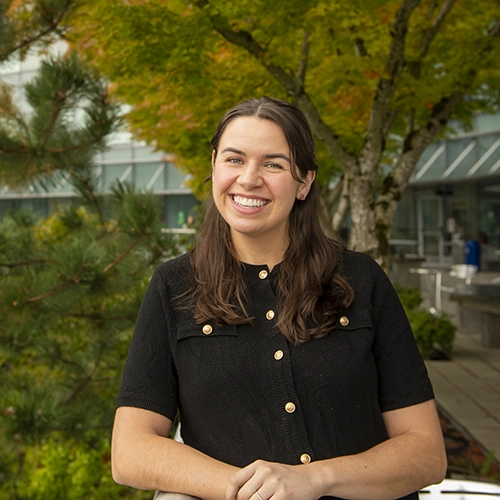

Katie (Kohler) Peters '17
When Katie (Kohler) Peters graduated from Linfield’s nursing program in 2017, she knew she was entering a stable and meaningful profession. What she didn’t fully know yet was just how many doors that degree would open.
Today, Katie is a certified registered nurse anesthetist (CRNA) at Oregon Health & Science University, where she provides anesthesia care across surgical settings — from eye surgeries at the Casey Eye Institute to outpatient procedures and cardiac labs.
Her journey is a powerful reminder that a Bachelor of Science in Nursing isn’t just a starting point — it’s a launchpad.
Katie didn’t begin college planning to become a nurse.
“When I started at Oregon State, I had gone for physical therapy,” she said. “But within my freshman year I switched ideas. With nursing, you get your four-year degree, and you have a career built in right then and there, and it’s a solid career. I don’t regret that at all. It has been a wonderful career for me.”
What drew her in was flexibility.
“In nursing, there’s just so many opportunities,” Katie said. “You can get an advanced degree. You can get managerial positions. You can work in hospitals or clinics or home health care. There are just so many options for it. I loved that flexibility that it came with.”
After transferring to Linfield to complete her BSN, Katie focused on earning strong grades and gaining critical care experience — steps that would later position her for advanced study.
“One hundred percent, Linfield gave me the right education, put me in the right clinical rotations and gave me the right opportunities,” she said. “Even the staff I worked with — staying connected with well-connected professors has been very, very important and vital. I’m very grateful for that.”
Katie went into nursing with long-term possibilities in mind.
“I kind of went into the program with the mindset of, let me prepare myself for the possibility of going back,” she said.
Because CRNA programs place strong emphasis on academic performance, she focused early on earning a strong GPA at Linfield. She was equally intentional about her clinical path, working toward a position in the intensive care unit — a key requirement for most nurse anesthesia programs.
“I focused on getting a good GPA through nursing school,” she said. “And I focused on getting into the ICU. So, I had those two checks — good GPA and ICU experience.”
A CRNA is an advanced practice nurse who specializes in anesthesia care. After working several years in the intensive care unit at PeaceHealth in Vancouver, Katie decided she was ready to apply to anesthesia school.
When that moment came, she reached back to Linfield.
She contacted Paul Smith, now dean of the School of Nursing, and asked if he knew any CRNAs in the community she could shadow. Smith connected her with a CRNA in Vancouver. Katie shadowed him, asked questions and learned more about the profession. That connection proved pivotal.
“Paul connected me to Matt, and Matt connected me to Midwestern,” she said.
The CRNA she shadowed had graduated from Midwestern University in Phoenix and later wrote Katie a letter of recommendation.
“He ended up writing me a letter saying that Katie would be a great applicant,” she said. “It helped me get on the interview list — to at least get in front of them.”
CRNA programs are highly competitive, and most now require a doctorate-level degree. Katie completed one of the final master’s-level anesthesia cohorts in 2023 before the field transitioned fully to doctoral preparation. She earned her Doctor of Nursing Anesthesia Practice (DNAP) in 2024.
CRNAs play a critical role in increasing access to surgical and procedural care, especially in rural communities.
“We are independent practitioners in about 30 states,” Katie said. “We provide more rural health care because of increased access to anesthesia, which increases surgical capabilities in those rural places. Patients have more access to get surgeries or procedures in their own hometowns instead of traveling.”
At OHSU, Katie works in a collaborative care model but says her training prepared her for the full scope of practice.
“As a CRNA, you get trained to do literally everything that’s in your scope,” she said. “I was trained on open hearts, pediatrics — everything. Do I practice it every day? No. But I can.”
Her work changes daily — and that variety is part of what she loves.
“It’s kind of fun. It’s different every day,” she said.
For Linfield students considering advanced practice roles like CRNA, Katie offers practical advice:
“Focus on your GPA. Try to connect into critical care. Learn as much about critical care as you can. If you have the opportunity to observe anesthesia staff during clinicals, ask questions. See how that whole world works.”
She encourages students early in their journey to explore broadly.
“Shadow. See if it’s something you’re interested in. And even if you don’t go on to become a CRNA, nursing is such a wonderful option. The flexibility, the schedule, the security and the pay — it’s a great field.”
Reflecting on her path, Katie returns to the foundation that made it all possible.
“With nursing, you get your four-year degree, and you have a career built in right then and there,” she said. “And if you want to go further, you can.”
At Linfield, that first degree doesn’t just prepare students for their first job — it prepares them for a lifetime of possibilities.